

June 21, 2026
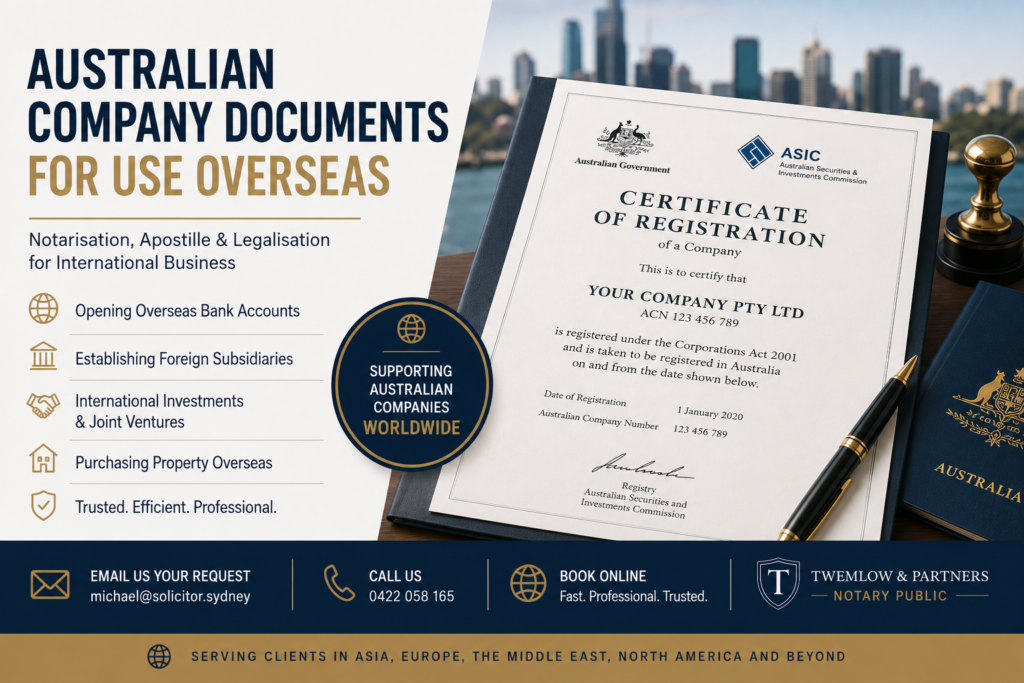
Australian companies are increasingly expanding overseas.
Whether establishing a foreign subsidiary, opening an overseas bank account, purchasing property overseas, attracting foreign investment or entering an international joint venture, foreign banks, lawyers, investors and government authorities often require Australian company documents before a transaction can proceed.
Many business owners first become aware of these requirements after receiving an email from an overseas bank or lawyer requesting a list of unfamiliar corporate documents.
We regularly assist Australian companies with the preparation, notarisation, Apostille and legalisation of company documents for use overseas.
Why Are Australian Company Documents Required?
Foreign organisations frequently need independent confirmation of:
- The existence of the company
- The identity of directors and officeholders
- The company’s registered office
- The authority of directors to act on behalf of the company
- The company’s corporate structure
- The company’s legal capacity to enter transactions
The exact requirements vary depending on the country and the nature of the transaction.
Common Company Documents Required Overseas
The documents most commonly requested include:
- Certificate of Good Standing
- Certificate of Incumbency
- ASIC Company Extracts
- Certificate of Registration
- Company Constitution
- Director Resolutions
- Shareholder Resolutions
- Powers of Attorney
- Commercial Agreements
- Beneficial Ownership Documents
Many overseas banks and government authorities require these documents to be notarised before they will be accepted.
Opening an Overseas Bank Account
One of the most common reasons Australian companies require notarised documents is to open an overseas bank account.
Foreign banks often require corporate documents to verify the identity and authority of the company before opening an account or approving a banking facility.
Requests commonly include Certificates of Good Standing, Certificates of Incumbency and ASIC company records.
Establishing a Foreign Subsidiary
Australian companies establishing subsidiaries, branches or representative offices overseas are frequently required to provide notarised corporate documents.
Foreign authorities often require evidence that the Australian company is properly registered and authorised to conduct business.
International Investments and Joint Ventures
Corporate documents are also commonly required when:
- Raising overseas investment
- Entering joint venture arrangements
- Acquiring foreign businesses
- Participating in international tenders
- Completing cross-border transactions
Investors, lawyers and regulators often require corporate due diligence documents before a transaction can proceed.
Apostille and Legalisation of Company Documents
Many countries require additional authentication after notarisation.
Depending on the destination country, documents may require:
- Apostille
- DFAT Authentication
- Embassy Legalisation
The requirements differ from country to country and depend on where the documents will be used.
Company Documents for Use Throughout the World
We regularly assist Australian companies with documents for use in:
- Singapore
- Hong Kong
- United Arab Emirates
- United Kingdom
- United States
- China
- India
- New Zealand
- Canada
- Germany
- France
- Switzerland
These are just a few examples. We regularly prepare company documents for use throughout the world.
Received a Request for Company Documents?
If you have received a request from an overseas bank, lawyer, investor or government authority, forward the request to us and we can advise on the documents required.
Whether the request involves a Certificate of Good Standing, Certificate of Incumbency, ASIC company documents, Apostilles or legalisation, we can assist.
Email michael@solicitor.sydney
Call 0422 058 165
Book Online