

June 21, 2026
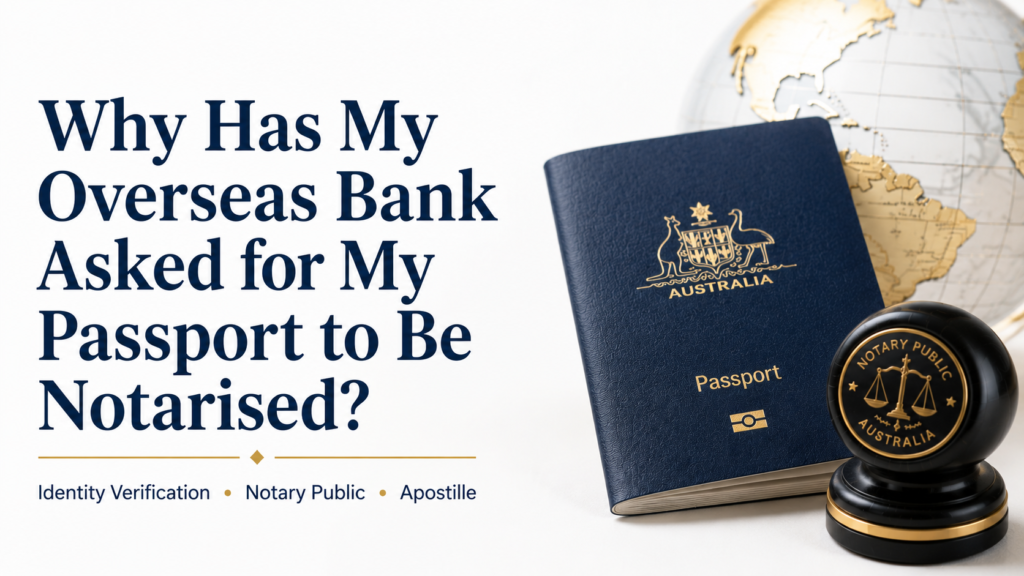
If you are opening an overseas bank account, applying for finance, transferring funds internationally or updating account authorities, you may have received an unexpected request from a foreign bank asking for a notarised copy of your passport.
Many Australians are surprised by this requirement.
After all, a passport is already a government-issued identity document. Why does a bank need it notarised?
Why Do Overseas Banks Require Notarised Identification?
When a bank is dealing with a customer who is located in another country, it often cannot verify the customer’s identity in person.
To manage this risk, banks commonly require an independent third party to verify:
- The identity of the customer
- The authenticity of identification documents
- The customer’s signature
- The authority of the person acting on behalf of a company or trust
A Notary Public is internationally recognised and can provide this verification.
What Is a Notarised Passport Copy?
A notarised passport copy is a copy of the original passport that has been certified by a Notary Public after inspecting the original document.
The Notary Public confirms that the copy is a true copy of the original passport produced.
Many overseas banks require a notarised passport copy before opening an account or processing an application.
Other Documents Commonly Requested
In addition to a passport, banks frequently request notarised copies of:
- Driver licences
- National identity cards
- Utility bills
- Bank statements
- Proof of address documents
- Trust deeds
- Company constitutions
- ASIC company records
The exact requirements vary depending on the institution and the country involved.
Opening Overseas Bank Accounts
We regularly assist clients opening accounts with banks located throughout:
- United States
- United Kingdom
- Singapore
- Hong Kong
- United Arab Emirates
- Switzerland
- New Zealand
- Europe
These are just a few examples. Requirements differ significantly between countries, institutions and individual banks.
Individuals, Companies and Trusts
Identity verification requirements do not only apply to individuals.
Foreign banks often require notarised documents relating to:
- Companies
- Directors
- Shareholders
- Beneficial owners
- Trusts
- Trustees
Additional corporate documents may also be required, including Certificates of Good Standing, Certificates of Incumbency and ASIC company records.
Is an Apostille Required?
Some overseas banks require only notarisation.
Others require the notarised document to be further authenticated by way of an Apostille issued by the Australian Department of Foreign Affairs and Trade (DFAT).
The requirements depend on the country and the institution involved.
Different Countries Have Different Requirements
There is no single international standard.
A document accepted by a bank in Singapore may not satisfy the requirements of a bank in the United States, Switzerland or the United Arab Emirates.
For that reason, it is important to carefully review the bank’s instructions before arranging notarisation.
Received an Identity Verification Request From an Overseas Bank?
If an overseas bank has requested notarised identification documents, send us the request and we can advise on the notarisation, Apostille or authentication requirements.
Call 0422 058 165
Email michael@solicitor.sydney
Book Online